


‘When diplomacy fails, there’s only one alternative: violence. Force must be applied, without apology. It’s the Starfleet way.’
It’s often said that history is written by the victors and while not often true, events are often relayed through time with a sense of bias. When it came to the USS Voyager getting in the middle of two warring factions, the story told over the centuries would become that of a warship led by a relentless Captain who’d commit genocide in exchange for the location of a wormhole that would get her crew home. War mongers from the other side of the galaxy blasting the Kyrians to pieces with biogenic weapons, abusing their powerful technology and murdering billions on a whim. That was the story passed through generations and retold through holographic re-enactments to visitors at a Kyrian museum, a historical record for all to learn from.
None of them knew it was a lie. Not until part of the relics from the battle uncovered the only person who was there. Voyager’s own Doctor. Well, kind of. Same person, same memory to a point. But a backup buried in the ruins of the past who was stunned to see how they were remembered; as collaborators of the Vaskans brought a reign of terror. The core story may be of Voyagers, butt he larger tale was to show how dangerous the Vaskans are and how responsible they are for the atrocities of the past. The museum is on big guilt trip. And after uncovering the Doctor, curator Quarren is faced with doubt about everything he had known to be true.
In the Doctors the Vaskans had asked for medical aid. The Kyrians boarded Voyager to intercept and assassinate the Vaskan leader. After centuries of being seen as a lesser people, the Vaskans are close to proof that they weren’t responsible for the war, weren’t the aggressors and had been fooled and bullied into an oppressive regime. And while faced with having to re-examine what the truth is, it all begins again…

Episodes that tend to last the test of time tend to be ones with themes that never seem to fade. On one hand it’s a compelling story of how the truth was distorted and how the Kyrans manufactured their own history to gain power and control. Theres also some nice elements from Robert Picardo getting yet another chance to show why he’s one of the cast’s finest while the rest of the regulars get a chance to ham up like a bunch of Terrans.
But the largely unspoken backstory is the key to why this works so well, even all this time later. Their society was built to elevate one side, and push another side down. A race seen as less than, subjugated by a ruling class and over the centuries of being told this story the tension has been bubbling until the Doctors presence throws the balance into chaos. It’s a story that’s been told since the first iteration of Star Trek and it’s not a story that’s came to an end in the real world either. If anything, since the episode was first seen, things have only gotten worse with a not so subtle rise in suprematist ideals to fantasy authors obsessively leading the charge to some of the most vulnerable minorities in the world.
Quarren is the one in the story who learns the lesson. Or at the very least, opens his mind to the idea that what he believes – both at this interpretation of history, as well as hows thats shaped an unbalanced division within his society. And in turn becomes that small glimmer of hope that’s been in the fabric of Star Trek since the beginning; science, truth, justice and overcoming prejudice so the divided instead become the greater whole.
Living Witness doesn’t give a full background. It doesn’t even give a solution. It only shows us that, while the world falls apart, even farther into the future they find the solution. We kind of skip to the end there. But we know that learning the truth about each other began the path to healing and thriving towards an equal society.
There’s some parts of the episode where you’d be forgiven for missing the parable and parts that leave you wanting more about what led to the first war, and how bad things got afterwards. But for the story they’re telling, it’s all just enough to give a fairly tight, self contained story that does what Star Trek always does best in using science fiction as a mirror to ourselves and our own societal baggage.
And just as it always has, gives you the smallest of hope that even if we’re still no closer to the ideals of the Star Trek future, maybe one day….


About the author

A Fistful of Spooky Encounters
Since it's inception Star Trek hasn't just been a sci fi show, but a show that used it's science fiction setting to tell a variety of stories from a large pool of themes and styles. And since we're officially in 'Spooky Season' on the countdown to Halloween, why not take a look at some of Star Trek's best dives into darkness? EMPOK NOR DEEP SPACE NINE, SEASON 5 Deep Space Nine is falling apart and thanks to the war, O'Brien can't exactly ask the Cardassians for spare parts. But he has a plan. Along with Nog and Garak, O'Brien leads an engineering crew to another abandoned Cardassian station to salvage what they can. Only problem is... there's a reason it was abandoned... Possibly the most straight forward horror story in the series, Empok Nor was host to an experiment gone […]
Delta Quarter Promotions & Citations: September 2026
Throughout it’s entire existence SFC has grown, evolved and thrived due to the commitment and passion of our officers and crew. Keen members can make a huge difference within their unit or the fleet as a whole, and we like to ensure members are rewarded and recognised for all they bring to the organisation. Starting this year, we're opening every new period within the fleet celebrating those who have made an impact and engaged in being a positive influence in their unit or in Q2 overall. And while we're getting in a little bit earlier, we'd like to introduce our Delta Quarter awards. While promotion is one of the most visible awards available to members, one of the most vital are our commendations. Commendations are a formal recognition awarded to members of Quadrant 2 who have shown commendable service and […]
Wibbly Wobbly, Timey Wimey: ‘Tomorrows Enterprise’, Strange New Worlds S4E10
Focusing on two timelines, Tomorrows Enterprise leads with Uhura of the present linked to her future as the two work together, manipulating the timeline to their advantage to solve the mystery of an undecipherable alien message, and a certain Scottish engineer who seems to have vanished from the timeline in the future... Writers: Henry Alonso Myers & Robbie Thompson. Director: Chris Fisher. In the present, there's some weirdness for Pike's Enterprise as they investigate a White Hole thats giving off some weird signals and an energy pulse that causes a temporal shift that directly effects Uhura after she hears strange sounds over comms. As she begins to hear things, such as Scotty screaming for help, her future self is going through some oddities of her own. A year in the future, the Enterprise is on the other side of […]
What If…. the Whales Were Never Extinct?
Fondly remembered as the lightest, more comedic entries in Star Trek's film offerings, The Voyage Home is the story of an alien probe coming to Earth to talk to it's whale pen pal, a little bit miffed that they've not had a letter in a while. In the 21st century, those pen pals – Humpback Whales – had been hunted to extinction. Meanwhile, Kirk and his disgraced crew were on the way home to stand trial and through some time warp shenanigans, take a stolen Bird of Prey back to the 20th century, kidnap some whales, and take them to the 23rd century to save the day. The charges against Kirk were a fairly big deal. Previously Kirk had stolen a soon to be retired Enterprise, went against orders and along with support from his long standing command crew barged […]
It’s a Kind of Magic: ‘Once La’an A Time’, Strange New Worlds S4E09
Developed by an alien tapping into the mind of M'Benga's daughter, turning reality into her favourite book, the Elysium Kingdom is now more reality than fantasy. Having morphed from a surreal experience to a flat-Earth like planet replica floating through space, the Elysium Kingdom lives on with it's evil queen continuing dream up new schemes. But the Kingdom's purpose has shifted with it arriving to unsubtly help one of the Enterprise crew... Writers: Onitra JohnsonDirector: Sydney Freeland Not quite by chance, the Enterprise runs into the 'unknown flat planet', a disc-shaped world moving through space with it's own power, air and life. Beaming down, Pike, Spock, Pelia and La'an find themselves in a fairy tale world. Complete with real fairies. And a fairy castle. After running into King Ridley, the part played by M'Benga in the season one episode, they […]
[Retro Review] The Doomsday Machine
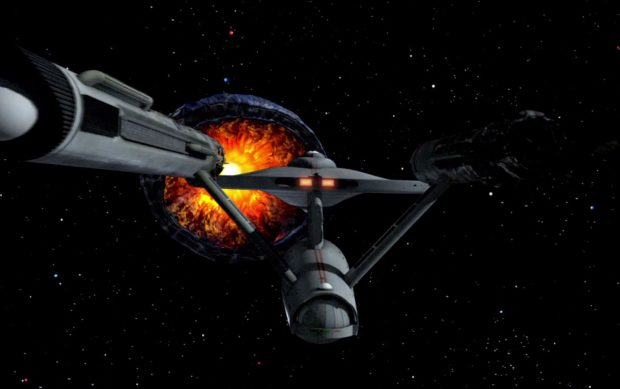
Responding to a distress call from the USS Constellation, the Enterprise race to the rescue but they arrive too late to save the day. Coming under fire from an alien entity, the Constellation has been heavily damaged and with only one survivor within it's charred shell; Commodore Matt Decker... Still in shock from the attack, Decker isn't able to say if it was an alien ship, or a creature that tore his ship apart. It doesn't take long to track the aliens flight path. It's not from around these parts, entering the Galaxy and on course towards populated areas that would undoubtedly be next in it's devastating path. Beaming on board with an away team, Kirk aims to try and get whats left of the ship back up and running while getting Decker to safety. But during the transit, the […]
Related
[Retro Review] Dagger Of The Mind
Dropping by a penal colony focused on rehabilitating the criminally insane, the Enterprise beams down some much needed supplies while one of the inmates sneaks on board to beg for asylum. But it's no regular stowaway. Dr Simon Van Gelder used to be part of the staff before he began to lose his mind and he's not just afraid of having dodgy meals and no windows, but reveals to Kirk that the facility runs through torture and abuse. Van Gelder arrived broken. His memories scattered, and any glimpse of those memories would trigger a painful and violent reaction. The colony's lead scientist and essentially warden, Dr Tristan Adams, waves it off claiming Van Gelder's techniques were tested on himself and that the rest of his story was delusional ramblings. Not entirely convinced, and given a heavy nudge by McCoy, Kirk […]
[Retro Review] The Doomsday Machine
Responding to a distress call from the USS Constellation, the Enterprise race to the rescue but they arrive too late to save the day. Coming under fire from an alien entity, the Constellation has been heavily damaged and with only one survivor within it's charred shell; Commodore Matt Decker... Still in shock from the attack, Decker isn't able to say if it was an alien ship, or a creature that tore his ship apart. It doesn't take long to track the aliens flight path. It's not from around these parts, entering the Galaxy and on course towards populated areas that would undoubtedly be next in it's devastating path. Beaming on board with an away team, Kirk aims to try and get whats left of the ship back up and running while getting Decker to safety. But during the transit, the […]
[Retro Review] Errand of Mercy
Relations between the Federation and the Klingons are in tatters and the prospect of an all out war casts a shadow over the region. To help prepare for the worst, Kirk and the Enterprise are sent to Organia, a planet populated by inherent pushovers right on the border between Federation and Klingon space. With the prospect of the Klingons getting a foothold that would help their war efforts, Kirk's job is to negotiate a protection order, getting the Organians on their side before the Klingons annexe the planet as a launching pad for conflict. Problem is, the Organians are hardcore pacifists and their native tech is limited. They don't want to be part of any war, and they don't want to change their values to resist. Which becomes a bit of a problem when the Klingons arrive ready to occupy the […]

[Retro Review] The Galileo Seven
Pulled in two directions, the Enterprise has to deliver critical medical supplies to avert a plague and conduct vital research at the same time. Unable to turn down the order, Kirk thinks on his feet by carrying forward to save the planet, while sending Spock to lead a research team on the Galileo shuttle to carry out their mission until the Enterprise has finished it's mission of mercy. It's a good idea. Until it isn't. Isolated form the Enterprise, the Galileo runs into a bit of bother. Thrown off course by plot, the shuttle crash lands on a primitive planet. Alone with a broken ship and a people who are as barbaric as they are terrified by the shuttles sudden arrival, Spock has to lead his own team through fear and frustration with cool and calming logic. On the first […]

[Retro Review] Space Seed
By chance, the Enterprise comes across an ancient Earth ship drifting through space. On board they find a whole bunch of people held in suspended animation, wake up the leader of the gang and accidentally unleash one of the most iconic villains of the franchise. Being coy with his identity at first, ship historian Marla McGivers becomes fascinated with a glimpse at the past while Kirk and the rest of the non-historians figure out that he just happens to be one of the most notorious war lords in Earths history... Star Trek, Season 1 , Episode 22 For all the action and adventure of deep space and the idea of using alien make up to mask more down to earth stories, Space Seed gives the first real glimpse of Star Trek's history. Khan is a relic of Earth from long […]

[Retro Review] Let This Be Your Last Battlefield
Often shown in highlight reels and quoted in discussions about Star Trek's more forward thinking messages, Let This Be Your Last Battlefield is at it's simplest, a story of the ridiculousness of segregation. En route to a vital mission of mercy, Kirk and his crew end up in the middle of a political minefield. Interrupted in the mission by a stolen Federation shuttle carrying an injured alien, Lokai from the planet Cheron, they're soon further interrupted by Commissioner Bele, an official representing Cheron who announces Lokai as a political traitor and demanding custody. One asylum request later, Kirk's stuck between the two trying to find the right course of action knowing he has orders to follow beyond the situation. The separation between Belle and Lokai is a simple context. And also a strangely charged one looking at it from a […]

