


A relic of one of Starfleet’s lost experimental era’s, the Einstein Class was in service into the 2230’s as a replacement for the Daedalus explorers. Going back to a more traditional saucer for the ships primary hull, a core feature of Starfleet’s first exploration vessels, the NX Class, it was a larger and chunkier configuration to allow more internal for an adaptable range of mission specifications.

Similar to standard scout ship designs, such as the USS Archer, the Einstein featured a singular warp nacelle protruding below the wide saucer housing two semi circular dual warp coils powered by four reactors allowing the vessel to reach warp 7 speeds with it’s base early 23rd century configuration. While similar designs had limited and condensed warp drive housing, the Einstein hosted a secondary hull connected above the saucer via a thick spine; the secondary hull mirrored typical Federation design with navigational deflector ahead, shuttle bay at the read and engineering central.
Before comfort became a common feature, the Einstein was built purely with function in mind. The bridge of the ship showcased it’s industrial design with tightly designed kinetic function stations under large displays above so vital information could be monitored from the captains chair. Both ahead of the flight control station and above each of the wall consoles were safety bars to hold onto through combat or rough travel; a vital safety measure eventually eliminated by mid-century thanks to improvements in internal dampening technology.
The industrial design was felt throughout the shop, with dark chrome’s and tight access corridors leading to a variety of specialist facilities ranging form top of the line science and research labs as well as widely skilled medical facilities. The upper engineering section was a cavernous open space with early technologies taking up a vast complex space in comparison to contemporary starships; a style choice that continued to a rear shuttle bay that was kept depressurised with airlock access to individually prepared shuttles for ground missions, transport or evacuation.
Due to it’s larger saucer compared to other ships of it’s era, such as the Walker Class, the Einstein had a higher number of crew at around eight hundred average and a modular internal design that could be adapted for each mission assigned. It was also more than capable of defending itself with dorsal and ventral dual phaser banks, several torpedo launchers and tertiary phaser cannons which could shoot down incoming ordinance with relative ease.
One of the last Einstein ships in active service was the USS Kelvin where George Kirk would serve as Starfleet’s youngest rising first officer; a record later broken by his youngest son James who would follow in his fathers footsteps. In an alternate reality, George Kirk died in action following an incursion by a mysterious vessel from the future.

In designing the ship as the USS Kelvin or the 2009 Star Trek film, the brief was fairly straight forward. The basic logic was to make it an obvious Star Trek design both inside and out; from, the base layout and design of the bridge, the shape of the corridors and to the simplicity of the saucer and external arrangement. Though with this being a previous iteration, similar cues were taken to make it feel more like an old submarine to contrast he stylised Enterprise that would be introduced later in the 2009 film.
Long Beach Generating Station was used as the base for the Engineering and shuttle bay sections of the ship; specifically chosen for having a worn down and industrial look that would reflect both expectations of a ships engine room from submarine or naval films, as well we with the wear and tear of being a real-world working facility. Internally set designer James Clyne would follow the lead of director JJ Abrams and Production Designer Scott Chambliss to craft a more run down and ageing internal set. Using submarine film inspiration, as well as packing in a lot or ideas from 1950’s sci fi blended in with the general shape and layout of the original sets, they managed to build a rugged predecessor to the original Enterprise that would, in some ways, carry over to the next production crew for Discovery’s USS Shenzhou.
Ship artist Ryan Church was tasked with the design of the ship itself, coming up with multiple variations before settling on the basic one-nacelled shape and unusual engineering hull placement. Much like his initial designs for the Enterprise itself, the Kelvin – known as the Iowa during the design process – followed a more 60’s inspired design. Final iterations of the design kept the proportions but roughed up some of the finer detail to give the ship a more basic appearance in line with what would follow in either timeline.
Further refining to the digital model was completed by Industrial Light and Magic, including adding retractable turrets and adding a large amount of wear and tear to the outer hull to show it’s decades of service searching through the unknown.
One of the more unique starships to be seen on screen, the Einstein Class has the rare honour of being one of the few elements added to what became known as the Kelvin Timeline movies that was designed to be from the Prime Timeline before the two diverged. Although it would be considered a relic of the modern era, the Kelvin-type Einstein Class is available for new captains to select in Quadrant 2!


About the author

A Fistful of Spooky Encounters
Since it's inception Star Trek hasn't just been a sci fi show, but a show that used it's science fiction setting to tell a variety of stories from a large pool of themes and styles. And since we're officially in 'Spooky Season' on the countdown to Halloween, why not take a look at some of Star Trek's best dives into darkness? EMPOK NOR DEEP SPACE NINE, SEASON 5 Deep Space Nine is falling apart and thanks to the war, O'Brien can't exactly ask the Cardassians for spare parts. But he has a plan. Along with Nog and Garak, O'Brien leads an engineering crew to another abandoned Cardassian station to salvage what they can. Only problem is... there's a reason it was abandoned... Possibly the most straight forward horror story in the series, Empok Nor was host to an experiment gone […]

Delta Quarter Promotions & Citations: September 2026
Throughout it’s entire existence SFC has grown, evolved and thrived due to the commitment and passion of our officers and crew. Keen members can make a huge difference within their unit or the fleet as a whole, and we like to ensure members are rewarded and recognised for all they bring to the organisation. Starting this year, we're opening every new period within the fleet celebrating those who have made an impact and engaged in being a positive influence in their unit or in Q2 overall. And while we're getting in a little bit earlier, we'd like to introduce our Delta Quarter awards. While promotion is one of the most visible awards available to members, one of the most vital are our commendations. Commendations are a formal recognition awarded to members of Quadrant 2 who have shown commendable service and […]
Wibbly Wobbly, Timey Wimey: ‘Tomorrows Enterprise’, Strange New Worlds S4E10
Focusing on two timelines, Tomorrows Enterprise leads with Uhura of the present linked to her future as the two work together, manipulating the timeline to their advantage to solve the mystery of an undecipherable alien message, and a certain Scottish engineer who seems to have vanished from the timeline in the future... Writers: Henry Alonso Myers & Robbie Thompson. Director: Chris Fisher. In the present, there's some weirdness for Pike's Enterprise as they investigate a White Hole thats giving off some weird signals and an energy pulse that causes a temporal shift that directly effects Uhura after she hears strange sounds over comms. As she begins to hear things, such as Scotty screaming for help, her future self is going through some oddities of her own. A year in the future, the Enterprise is on the other side of […]
What If…. the Whales Were Never Extinct?
Fondly remembered as the lightest, more comedic entries in Star Trek's film offerings, The Voyage Home is the story of an alien probe coming to Earth to talk to it's whale pen pal, a little bit miffed that they've not had a letter in a while. In the 21st century, those pen pals – Humpback Whales – had been hunted to extinction. Meanwhile, Kirk and his disgraced crew were on the way home to stand trial and through some time warp shenanigans, take a stolen Bird of Prey back to the 20th century, kidnap some whales, and take them to the 23rd century to save the day. The charges against Kirk were a fairly big deal. Previously Kirk had stolen a soon to be retired Enterprise, went against orders and along with support from his long standing command crew barged […]
It’s a Kind of Magic: ‘Once La’an A Time’, Strange New Worlds S4E09
Developed by an alien tapping into the mind of M'Benga's daughter, turning reality into her favourite book, the Elysium Kingdom is now more reality than fantasy. Having morphed from a surreal experience to a flat-Earth like planet replica floating through space, the Elysium Kingdom lives on with it's evil queen continuing dream up new schemes. But the Kingdom's purpose has shifted with it arriving to unsubtly help one of the Enterprise crew... Writers: Onitra JohnsonDirector: Sydney Freeland Not quite by chance, the Enterprise runs into the 'unknown flat planet', a disc-shaped world moving through space with it's own power, air and life. Beaming down, Pike, Spock, Pelia and La'an find themselves in a fairy tale world. Complete with real fairies. And a fairy castle. After running into King Ridley, the part played by M'Benga in the season one episode, they […]
[Retro Review] The Doomsday Machine
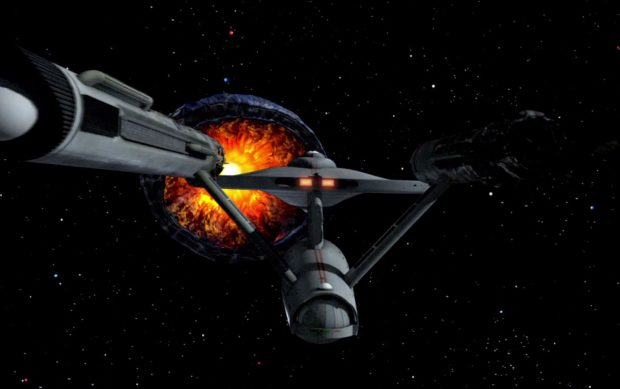
Responding to a distress call from the USS Constellation, the Enterprise race to the rescue but they arrive too late to save the day. Coming under fire from an alien entity, the Constellation has been heavily damaged and with only one survivor within it's charred shell; Commodore Matt Decker... Still in shock from the attack, Decker isn't able to say if it was an alien ship, or a creature that tore his ship apart. It doesn't take long to track the aliens flight path. It's not from around these parts, entering the Galaxy and on course towards populated areas that would undoubtedly be next in it's devastating path. Beaming on board with an away team, Kirk aims to try and get whats left of the ship back up and running while getting Decker to safety. But during the transit, the […]
Related

[Ships of the Line] The Galaxy Class
The peak of mid-24th century design, the Galaxy Class was one of the fleet's most iconic capitol ships that inspired a whole new generation of Starfleet. Built for longevity, the Galaxy was conceived as a deep space exploration cruiser that was not only an adaptable megastructure of science and research, but one that was entirely self sustainable whilst giving it's crew all the creature comforts they need for years, or even decades, without having to turn back home. The key to the Galaxy Class' success was in large part down to it's modular design. It's vast internal space, mainly within the ships primary hull, was designed with extreme flexibility in mind to the point that some ships, including the flagship Enterprise, were launched with around a third of it's internal volume vacant for later improvements or mission specific adaption. Deck […]

[Ships of the Line] Send ‘nubes! The Danube Class Runabout
The world of Star Trek is filled with graceful and elegant ships, huge forces of nature packed to the rafters with a bustling crew with every skill imaginable under one roof for any situation. But not all of the fleet's numbers are massive hulks ready for adventure. Sometimes you just need a little runner to get you from one place to another for missions that might last a few weeks more than a few years. Put into action in the late 2360's, the Danube Class Runabout was ideal for short term missions or teams that needed more than a cramped and empty transport shuttle to get the job done. At at least four or five times the size of a standard shuttlecraft, the Danube class was a step up from the range of short-range craft. Designed as a tightly condensed […]

[Ships of the Line] The Pathfinder
Building upon the discoveries and experiences of Voyager's unplanned trip through the Delta Quadrant, the Pathfinder class is the first line of starships designed specifically for the Delta Quadrant. Less a replacement for the Intrepid and more of a specialised offshoot, the Pathfinder was conceived for a return to the Delta Quadrant with a ship and crew prepared for what to expect. [Image Note: Pathfinder Class model by Thomas Marrone. Screencap taken in Star Trek Online with Sovereign Refit Livery.] After being stranded in the Delta Quadrant, the USS Voyager returned to Earth in 2378 with a little intervention from their future selves, Borg transwarp conduits and enough technology from the future that would drive Temporal Investigations to insanity. Between the new technologies brought in by Admiral Janeway to the discoveries and modifications applied to the ship throughout it's isolated […]

[Ships of the Line] The Ambassador Class
A stepping stone between two pivotal design era's, the Ambassador Class was introduced by the 2320's as a replacement for the Excelsior and Constellation lines before being itself replaced with the larger and more adaptable Galaxy Class. Constructed during a time of cautious optimism in the decades following the original Khitomer conference and relative silence from the Romulan Empire. Strong and sturdy in it's nature, the Ambassador line were installed as a key front line heavy cruiser as a deterrent against enemies of the Federation to take advantage of the relative peace of the early 24th century. Traditional in it's layout, the design process was more drawn out than most and included several variations in style and layout before a more solid and simple base was produced for the final model which included a traditional secondary hull linking back to […]

[Ships of the Line] Dauntless Class (2380’s)
In 2374 the crew of Voyager, stranded in the Delta Quadrant were given a life line; an advanced Starship complete with slipstream drive that would reduce the time of their journey back to Earth form decades to months. Appearing alongside an introduction form Starfleet, the Dauntless appeared to be the next step of Starship evolution. Until they realised it was all a lie – an alien ship dressed up as a Federation ship in a revenge plot that would have led the all to their deaths. Despite the truth being revealed, Voyager's crew had extensively studied the Dauntless and would later try and apply some of the research in an abandoned mission. Once they did return home, thanks to the Borg transwarp network, the Dauntless research was handed over to Starfleets R&D division to reverse engineer their findings and create […]

Relay Recap: July 2024
All Features Universe Categories Fleet Alert Comms GORN GIRL recap; july 2025 Picking up on the Season 2 cliff-hanger, Strange New Worlds returned to our screens this month to find Captain Pike and his crew on the edge of war with the Gorn as Season 3 was finally released!Exploring new worlds and new problems, the Enterprise crew are back in action on Paramount Plus and we're keeping ourselves up to date with weekly episode discussion threads on our FB Continuing Mission Group & Weekly episode reviews from Admin ! Explore... Episode Reviews Spoilers Group ACROSS THE UNIVERSE As we look back on Pike's adventures on the Enterprise in the prequel series, Paramount also gave us a look at whats to come next as Entertainment Weekly and SDCC's Star Trek Universe panel gave us a sneak peek at the reopening of […]

